Marketing for shops, counted in orders.

We get your products found, bring in buyers and bring them back, and we report on the orders in your shop, not on what an ad platform claims. Storefronts built or improved where the shop itself is the limit.

Small points of light moving along thin paths and gathering into one bright cluster

What it is

One shop, one set of numbers.

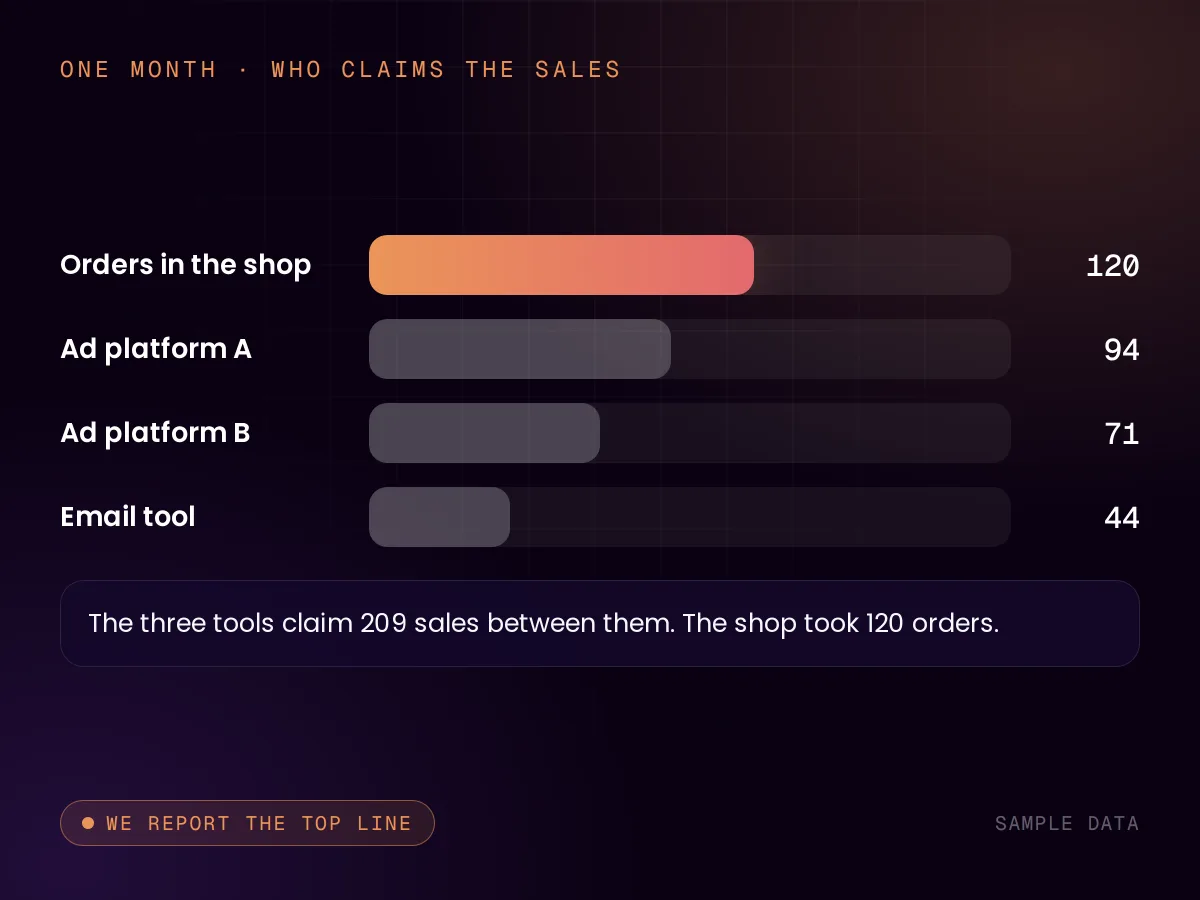
An ecommerce marketing agency usually sells channels: search, shopping ads, social ads, email. Each channel then reports its own sales, and the totals add up to more than the shop took in. The shop’s own order list is the only number that pays the bills.

So we start there. Chris de Gruijter, our founder, has built and worked on shops on Shopify, WooCommerce, headless Shopify and custom builds with Stripe. He does the work, with AI agents for the repetitive parts: feeds, search, ads, email flows and the tracking that ties them to real orders.

Where sales are lost

Why a full cart does not become an order.

Baymard Institute puts the average cart abandonment rate at 70.22%, from 50 studies. Many of those shoppers were only browsing. Baymard asked the others why they left, and most reasons sit in the shop, not in the marketing.

Reasons for leaving a cart, Baymard Institute survey

  • Extra costs too high40%

    Pricing Shipping, tax and fees that appear late. More traffic does not fix this.

  • Delivery too slow20%

    Operations Say the delivery time on the product page, before the cart.

  • Did not trust the site with a card19%

    Storefront Known payment methods, a clear returns page, a site that looks looked after.

  • Had to create an account18%

    Checkout Offer checkout as a guest.

  • Checkout too long or complicated17%

    Checkout Fewer fields and fewer steps.

  • Website had errors17%

    Storefront Found by testing the checkout on real phones.

  • Returns policy not good enough13%

    Policy A business decision, shown clearly.

  • Could not see the total cost up front12%

    Checkout Show the full price early. In the UK, adding fees step by step is now banned.

From Baymard’s survey of online shoppers in the United States, with people who were only browsing left out; more than one answer was possible. Shares for your shop and country will differ.

Sources: Baymard Institute, cart abandonment rate statistics (opens in a new tab), Competition and Markets Authority, new consumer protection regime (opens in a new tab)

What we do

Found, bought, bought again.

Getting found

Your products in Google, with correct data.

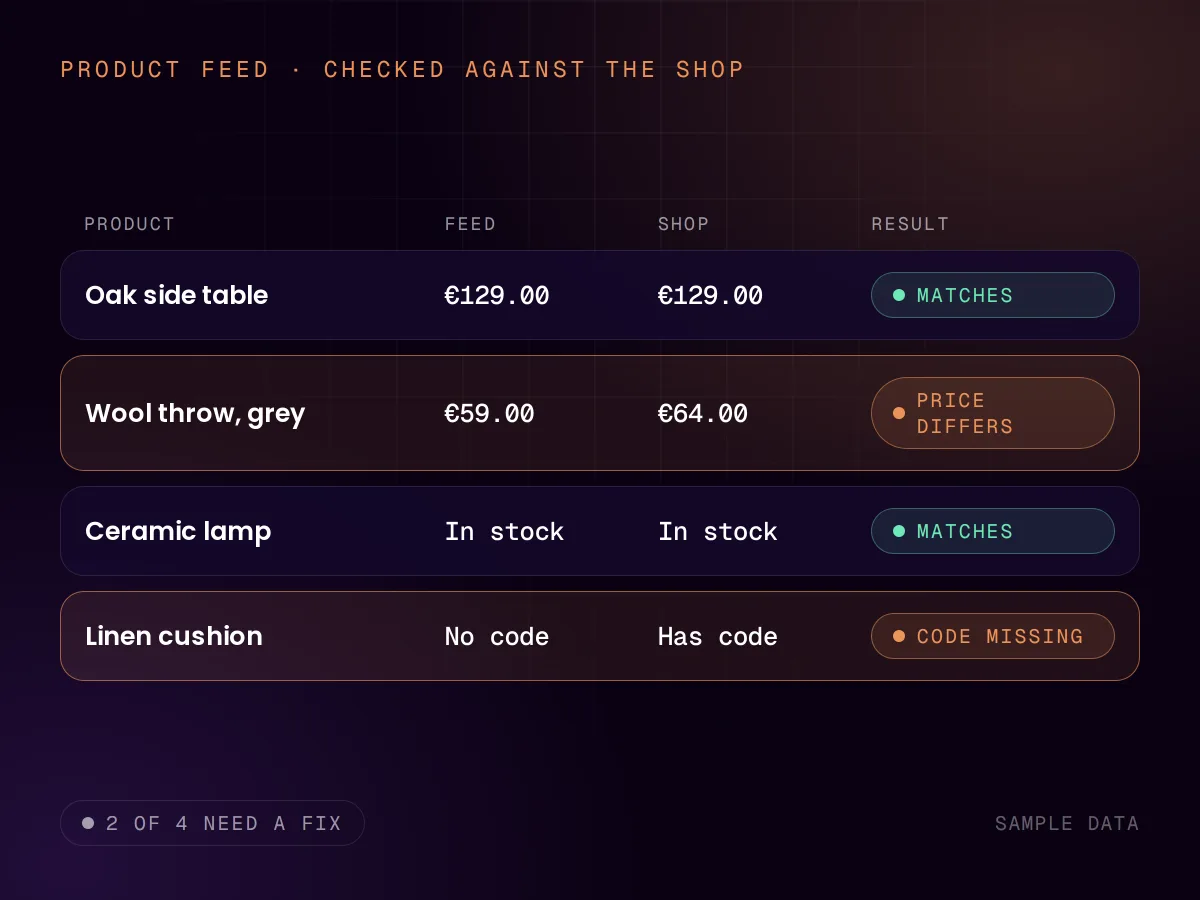
Google shows products from your feed for free across Search, the Shopping tab, Images, Maps and YouTube, and the same feed drives Shopping ads. The feed has rules. The price and stock in it must match your product page and your checkout. A wrong product code gets the product disapproved; Google’s advice is not to guess one.

We build and maintain the feed. On a shop we built or host we also add the product data Google reads on the page and improve the category and product pages ourselves; on any other shop you get a task list for your developer, or we quote the work. From 31 January 2027 Google will also enforce a minimum image size of 500 by 500 pixels.

  • A product feed that matches the shop
  • Disapproved products found and fixed
  • Category and product pages for search
Email and repeat

Bring buyers back without buying the click again.

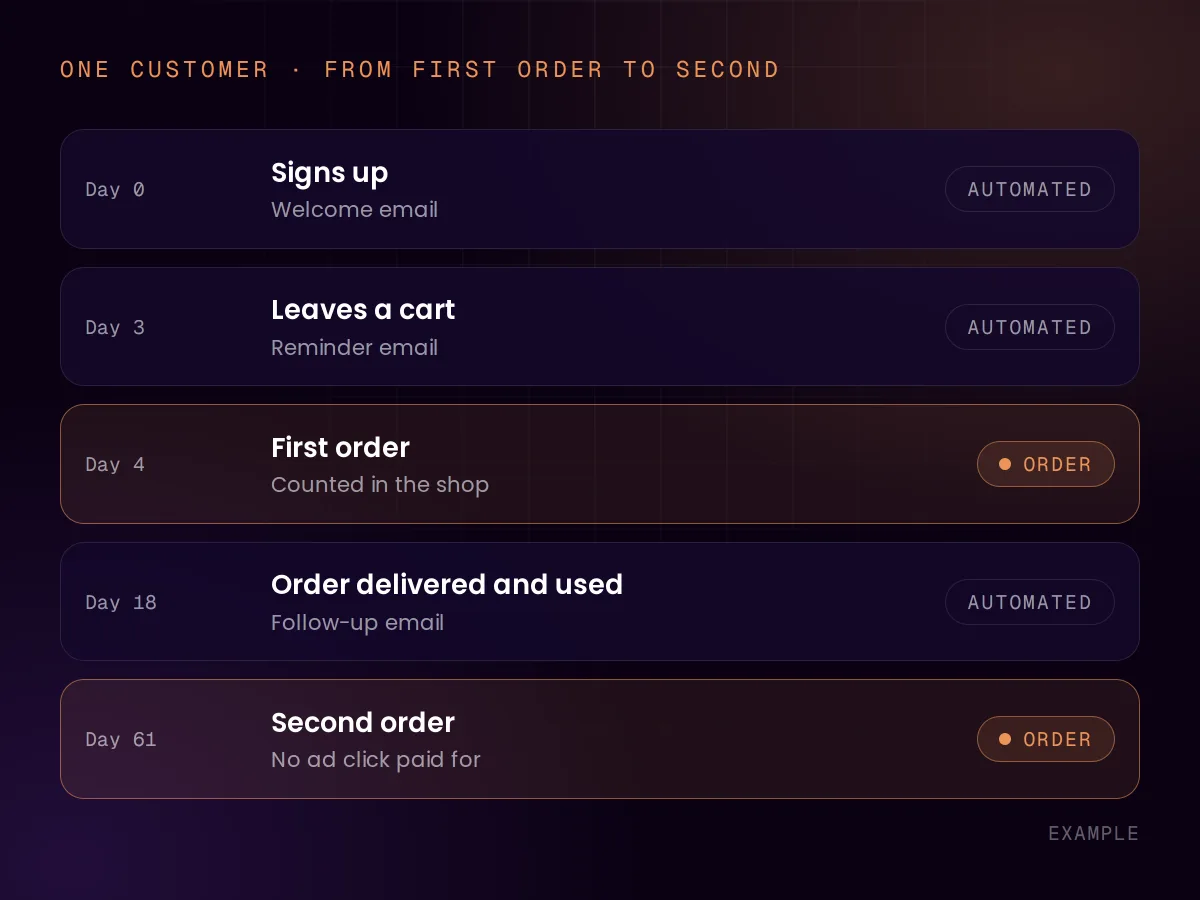
A buyer you already have can be reached without paying for the click again. The automated emails do most of this work: a welcome, a reminder for a cart or a product left behind, a follow-up after the purchase, and a message to customers who have gone quiet.

These flows are built in your own email account, to people who agreed to hear from you. Discounts in them follow the same rules as on the site: in the EU a price reduction must, as a rule, show the lowest price of the past 30 days.

  • Welcome, cart, post-purchase and win-back flows
  • Built in your own email account
  • Measured on orders, not on opens

Storefronts

Shopify, headless or custom.

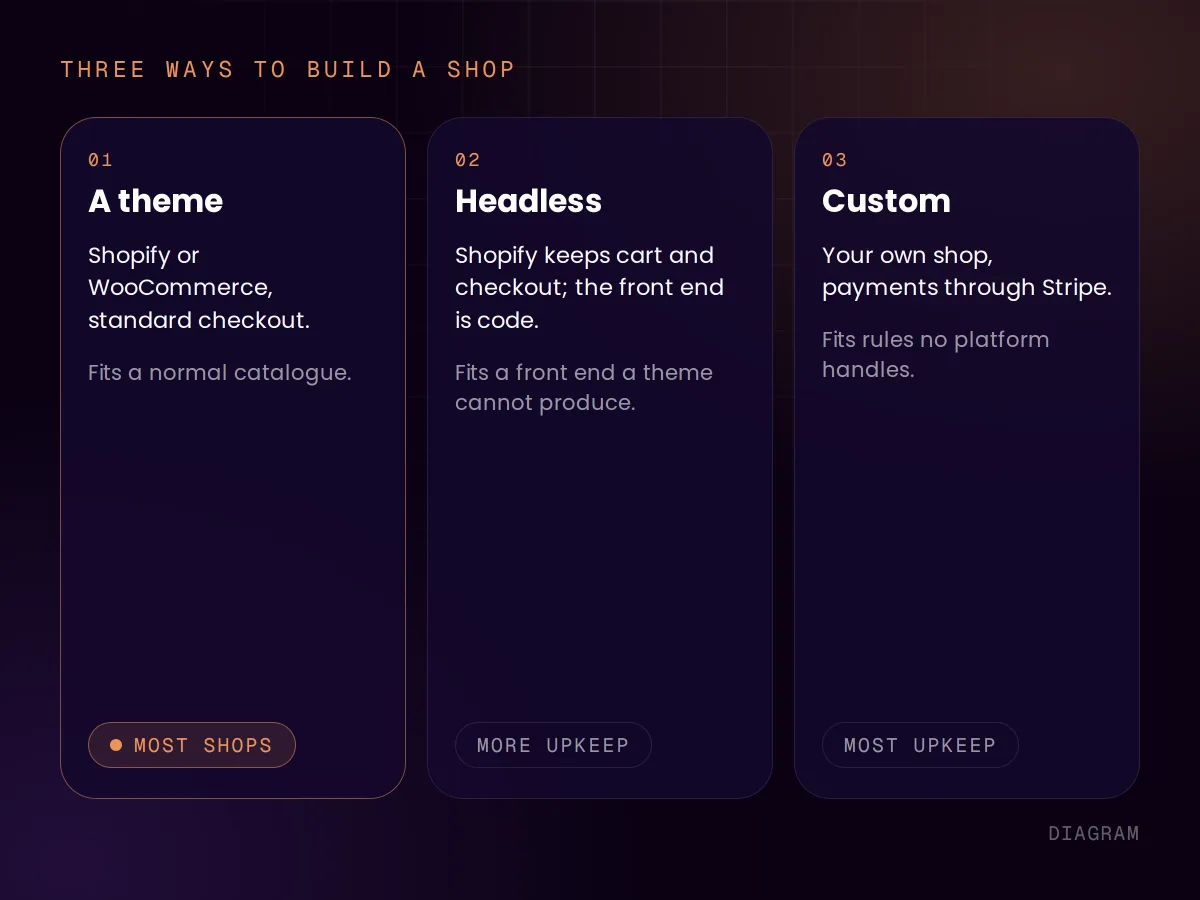
Sometimes the shop itself is the limit: a slow theme, a checkout that asks too much, a catalogue the platform does not fit. We build and improve storefronts on Shopify and WooCommerce, headless Shopify with a custom front end, and custom shops with Stripe for payments.

For most shops a standard Shopify theme is enough. Shopify itself writes that a headless storefront “costs more to build and run than a theme” and needs developers after launch. We recommend it only when a theme and apps cannot do what the business needs.

  • Themes and checkout improved on your platform
  • Headless or custom when a theme cannot do it
  • Feed, tracking and consumer information built in

Sources: Google Merchant Center, product data specification (opens in a new tab), Google Merchant Center, free listings (opens in a new tab), Meta, handling duplicate Pixel and Conversions API events (opens in a new tab), Google Analytics, behavioral modeling for consent mode (opens in a new tab), Your Europe, unfair pricing (opens in a new tab), Shopify, headless commerce (opens in a new tab)

Which storefront

When Shopify is enough.

The cheapest shop that does the job is the right one. This is how we advise.

Your situation
A standard catalogue and a normal checkout Most shops
What fits
A Shopify or WooCommerce theme
Why
Quick to launch, and many developers know it.
Your situation
Changes needed inside the checkout steps
What fits
Shopify Plus
Why
Apps on the information, shipping and payment steps are available only on Plus.
Your situation
A front end a theme cannot produce, or one shop feeding several sites
What fits
Headless Shopify
Why
Shopify keeps products, cart and checkout; the front end is built in code.
Your situation
Subscriptions, quotes or pricing rules no platform handles
What fits
A custom shop with Stripe
Why
Built around your process, with the upkeep that comes with custom code.

Plan features from Shopify’s own pages, read on 15 November 2026. Shopify’s prices differ per country, so we quote them with the proposal.

Sources: Shopify Help Center, checkout customization (opens in a new tab), Shopify, pricing (opens in a new tab)

The rules for shops

What the law asks of an online shop.

Marketing claims and checkout pages fall under consumer law. These are the basics in the regulators’ own words. This is general information, not legal advice.

Fourteen days to cancel
In the UK you must tell customers they can cancel up to 14 days after delivery, without giving a reason. The Netherlands has the same 14 days. In both, the period is extended by up to a year when the customer was not told. Some goods are excluded, such as made-to-measure or personalised items and goods that spoil quickly.
Honest discounts
In the EU, as a rule, a trader who announces a discount must show the lowest price charged in the 30 days before it.
Real reviews only
UK law bans posting and commissioning fake reviews. The Competition and Markets Authority can fine a business up to 10% of its global turnover.
The full price up front
The same UK law bans drip pricing, where fees are added step by step. UK guidance for online sellers also lists the price including all taxes, and the delivery costs, among what a customer must be told before ordering.

Sources: GOV.UK, online and distance selling for businesses (opens in a new tab), ACM ConsuWijzer, bedenktijd (opens in a new tab), Your Europe, unfair pricing (opens in a new tab), Competition and Markets Authority, new consumer protection regime (opens in a new tab)

Honest scope

No promised return.

A return on ad spend depends on your margin, your prices and how much demand there is for what you sell. We do not put a number on it before we have seen the shop.

What we commit to

  • Reporting on orders in your shop.
  • A product feed that matches your prices and stock.
  • Ad accounts and email list in your name.
  • A flat fee, agreed before we start.
  • A plain message when the shop, not the marketing, is the problem.

What nobody can promise

  • A return on ad spend or a revenue figure.
  • A position in Google or in the Shopping results.
  • That every product is approved by Google.
  • That a visitor who was only browsing will buy.
  • The same result in a quiet month as in a busy one.

How we work

Count, fix, grow, report.

  1. 01 · Count

    Start from the orders

    Your shop’s orders next to what each platform reports, and where the two differ.

  2. 02 · Fix

    Feed and tracking

    The product feed, the purchase tracking and the checkout problems that cost orders now.

  3. 03 · Grow

    One channel at a time

    Search, shopping ads or email, starting with the one your numbers point to.

  4. 04 · Report

    Monthly, in orders

    Orders and revenue from the shop, per channel, and what we change next.

Pricing

Per service

Managing your ads costs a flat fee from €250 a month. An SEO audit starts at €750 and a tracking audit at €500. Email flows cost €500 to €5,000 to build. A storefront is quoted per shop. Each price is fixed and agreed before we start. For UK clients we quote in pounds on request. See all pricing

FAQ

Questions about Ecommerce Marketing

Reviewed by Chris de Gruijter,

See what your shop really sells per channel.

Start with the free AI Scan, or tell us about your shop.