Leads you can count, and call.

We build the system that captures your leads, filters out the junk, counts each one once and puts it in your CRM with its source. Outreach to new businesses is available on request.

Wide scatter of light points passing through a row of gates and gathering on the far side, for Lead Generation

What it is

A lead is only a lead if it is real.

Lead generation is often sold as volume: so many leads or appointments a month, sometimes with a guarantee. Volume is easy to produce and hard to use. A form filled in by a bot is a lead on a report and nothing in your diary.

We work the other way round. First make sure every real enquiry is caught, counted once and followed up. That alone can change the picture before any new traffic is bought. Then add more at the top: better pages, ads, and outreach where it is allowed.

What gets counted

From a hundred forms to the leads worth a call.

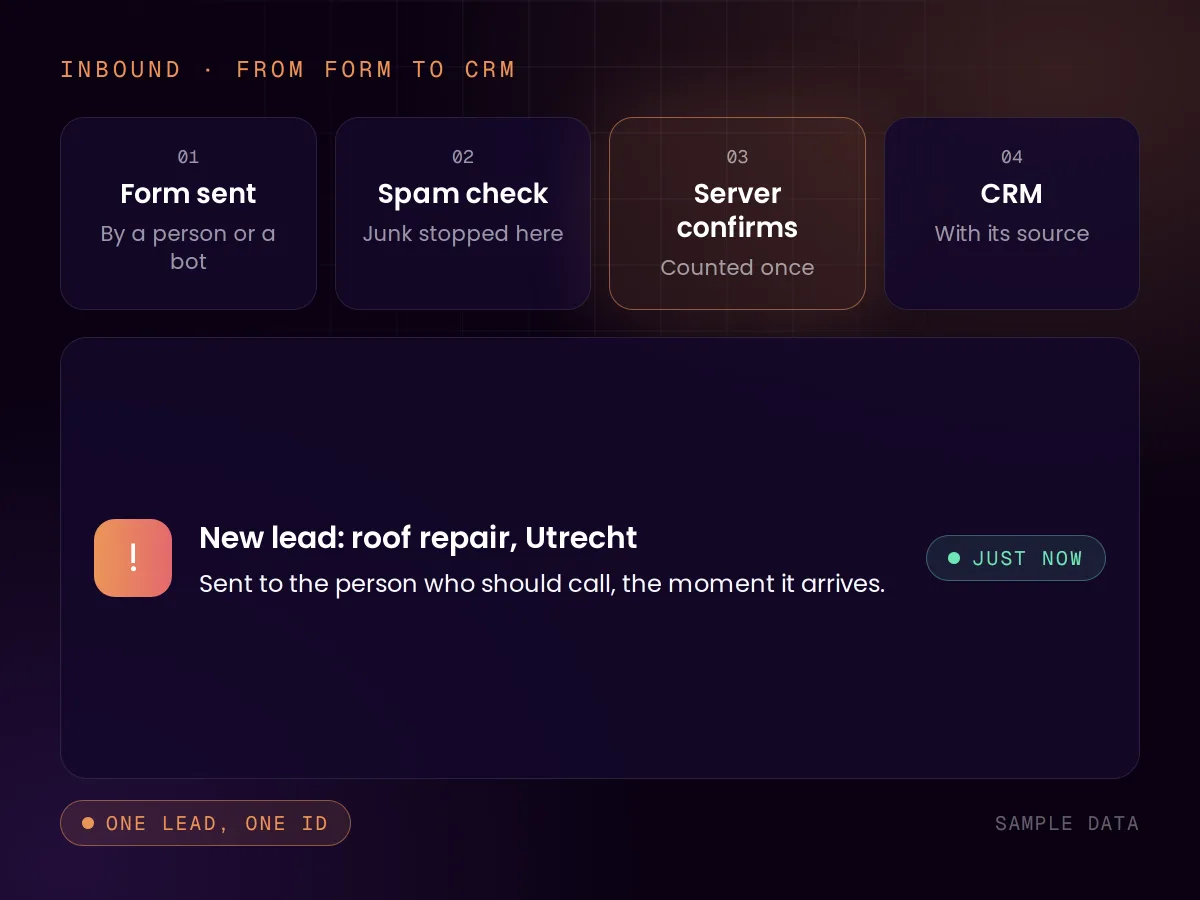
This is what happens between someone pressing send and a lead appearing in your CRM. Each step removes something that would otherwise be reported as a lead.

Form submissions in one month (sample data)

  1. Submitted100

    Everything that reached the form, from people and from software.

  2. After the spam filter7228 stopped

    An invisible check stops most bots, and a rule set catches known junk senders before anything reaches your inbox or CRM.

  3. Counted once666 duplicates

    A refresh, a double click or a retry is the same person. Each lead gets its own id and counts one time, once the server has confirmed it. This is the number sent to your ad platforms.

  4. A fit for your business4125 marked low priority

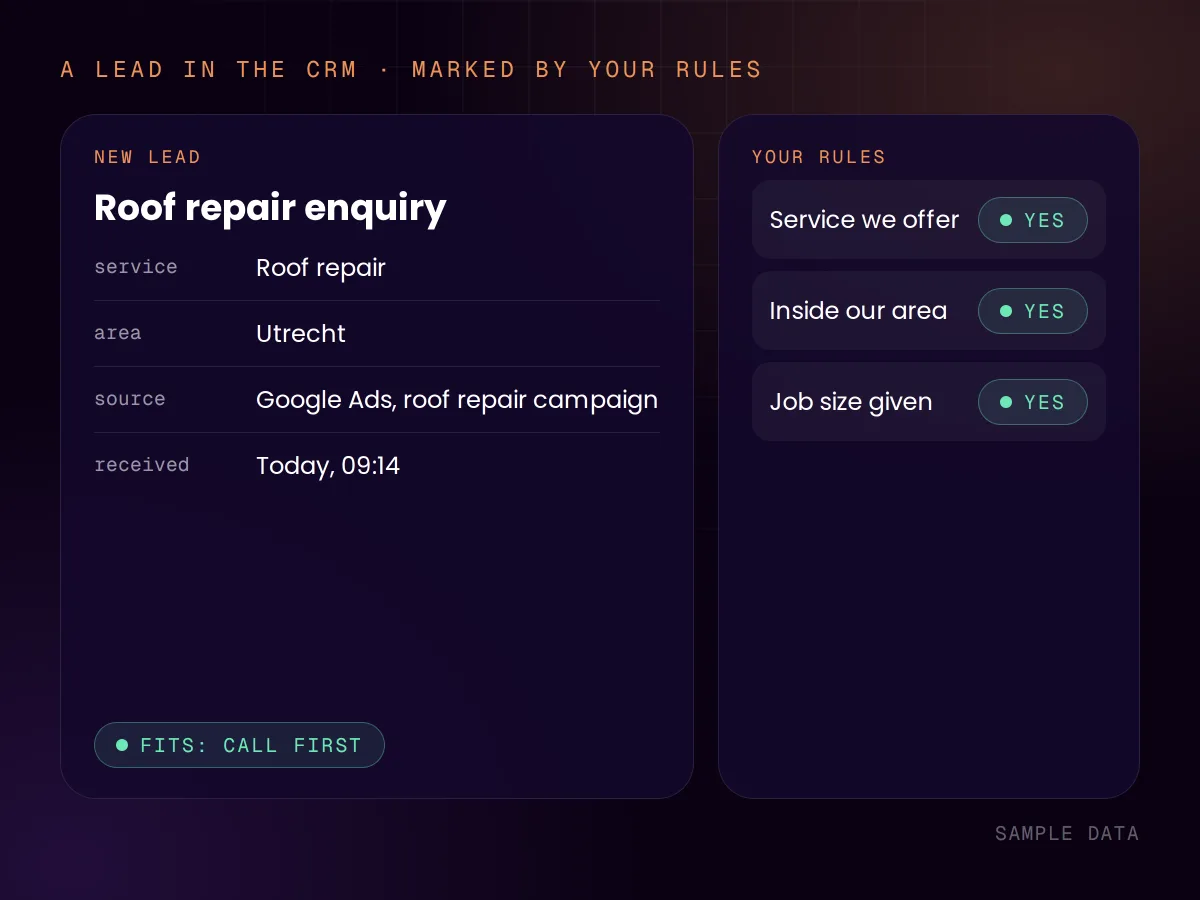
    Your own rules decide: the service asked for, the area, the size of the job. Nothing is deleted. Every lead is in your CRM with its source, and the ones that fit are the ones to call first.

Sample figures to show the steps, not a client’s data. The share removed at each step differs per website.

Sources: Cloudflare, Turnstile (opens in a new tab)

How leads come in

Inbound first, outreach on request.

Inbound

Catch every enquiry you already earn.

Inbound leads come to you: someone searches, lands on a page and fills in a form or calls. It is where we start, because these people are already looking. The work is in the page that convinces them, the form that does not get in the way, and what happens in the first minutes after they press send.

Speed matters more than most businesses assume. The authors of a Harvard Business Review study of online sales leads concluded that “most companies are not responding nearly fast enough”. A lead that lands in the CRM at once, with a notification to the right person, removes the usual reason for the delay.

  • Pages and forms built to be completed
  • Spam stopped before it reaches you
  • A notification the moment a lead arrives
Outbound

Reaching out, with a person in the loop.

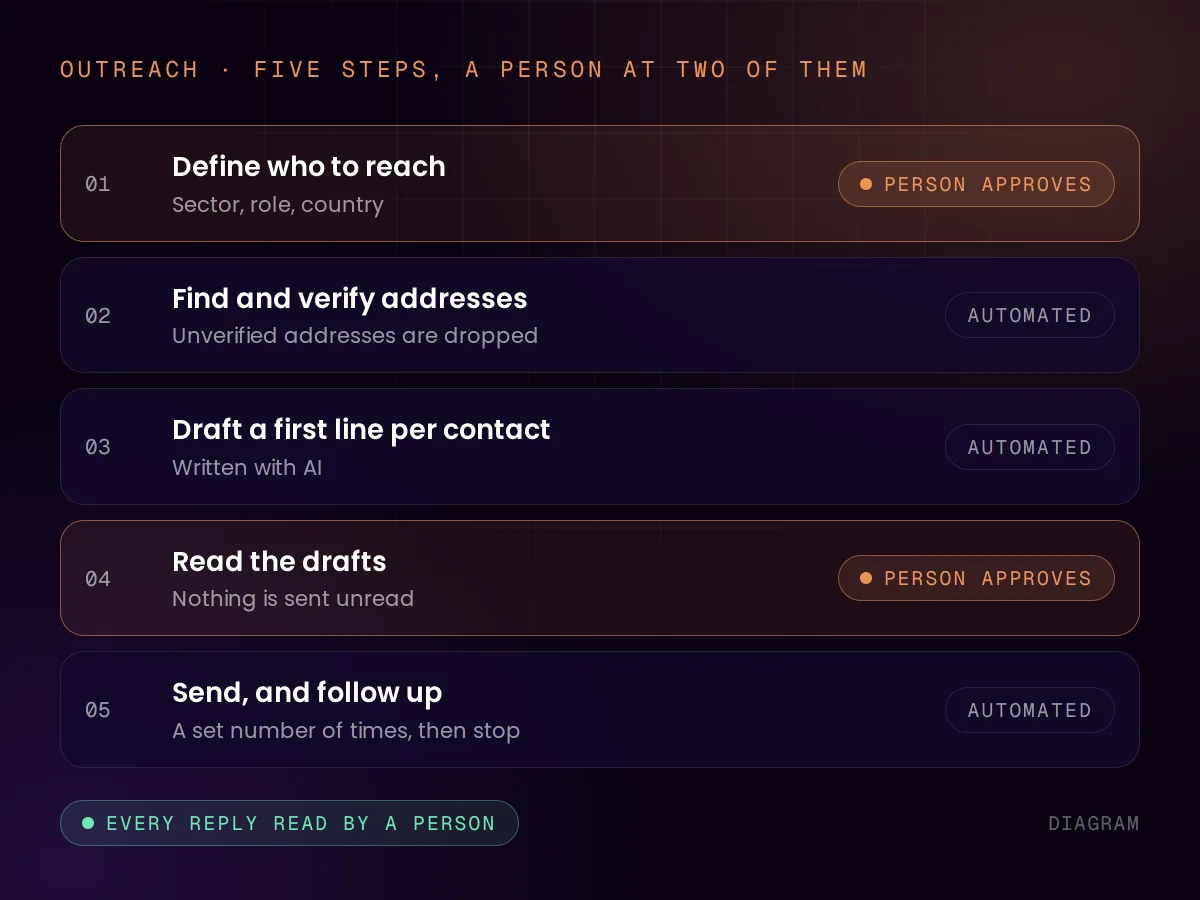
Outbound means contacting businesses that have not contacted you. We have run outreach campaigns for clients before, by email and on LinkedIn, and we build it on request. The steps are the same each time: decide exactly who you want to reach, find the decision makers, verify the addresses, write a first line that is about them, and follow up a set number of times.

AI drafts the first lines. A person reads them before anything is sent, and a person reads every reply. Whether we may email a business at all depends on the country it is in, which is the next section.

  • A defined audience, not a bought list
  • Addresses verified before sending
  • Every reply read by a person

Qualify and hand over

Not every lead deserves the same call.

A lead for a job you do not do, in an area you do not serve, costs time. Qualifying is deciding, from what the person told you, how soon and by whom they should be called. The rules are yours: service, location, size of the job.

We put those rules into the form and the hand-over, so each lead arrives in your CRM marked and in the right queue. The dashboard then shows leads received per channel, counted on the server, which is the same number your monthly report uses.

  • Your own rules for a good lead
  • Each lead marked and routed
  • One count for dashboard and report

Sources: Oldroyd, McElheran and Elkington, The Short Life of Online Sales Leads, Harvard Business Review, March 2011 (opens in a new tab)

Cold email and the law

Whether you may email a business depends on where it is.

The UK and the Netherlands have opposite starting points. We follow the rule of the recipient’s country, and where a country requires consent we do not send cold email there. This is general information, not legal advice.

Recipient
A company
United Kingdom
The email marketing rule does not apply to corporate subscribers: no prior consent is needed under it.
Netherlands
Prior consent is needed, also when the recipient is a business.
Recipient
A sole trader or some partnerships
United Kingdom
Treated as an individual: consent is needed, or the soft opt-in for existing customers. Limited liability partnerships and Scottish partnerships count as companies.
Netherlands
Prior consent is needed.
Recipient
The exceptions
United Kingdom
None needed for companies. You must still identify yourself and give a valid address to opt out.
Netherlands
An address the business published for receiving commercial offers, an existing customer, for your own similar products or services, or a recipient established outside the European Economic Area.
Recipient
A named person
United Kingdom
Data protection law still applies to a named contact. The right to object to direct marketing is absolute, and objectors should be kept on a do-not-contact list.
Netherlands
People must be able to object, free and easily, every time a message is sent.

From the UK Information Commissioner’s Office, article 11.7 of the Dutch Telecommunicatiewet and the Autoriteit Persoonsgegevens, read on 15 November 2026. The ICO notes that its guidance is under review following the Data (Use and Access) Act. Other countries differ again; we check the rule before any campaign.

Sources: ICO, business-to-business marketing (opens in a new tab), Telecommunicatiewet, article 11.7 (opens in a new tab), Autoriteit Persoonsgegevens, digital direct marketing (opens in a new tab)

Your domain and your data

What outreach puts at risk, and who owns it.

Cold email sent carelessly damages the reputation of the domain it comes from. Mailbox providers now publish the rules they enforce.

A separate sending domain
Outreach goes from a domain set aside for it, so your main domain and your normal email are not put at risk. The domain is registered in your name.
The providers’ rules, met
Google requires every sender to authenticate its mail and keep reported spam below 0.10% and avoid ever reaching 0.30%. Above 5,000 messages a day to Gmail accounts, the full set of authentication and one-click unsubscribe is required. Microsoft applies similar rules to high-volume senders.
A do-not-contact list
Anyone who objects is never contacted again. The UK regulator advises keeping objectors on a suppression list instead of deleting them, so they are not added again by accident.
The list is yours
The mailboxes, the contact list and the replies are set up in your accounts and stay with you.

Sources: Google, email sender guidelines (opens in a new tab), Microsoft, requirements for high-volume senders (opens in a new tab), ICO, business-to-business marketing (opens in a new tab)

Honest scope

No guaranteed numbers.

Agencies that charge per lead are paid for volume, so volume is what you get. We charge for building and running the system, and we do not promise a count.

What we commit to

  • Every real enquiry caught and counted once.
  • Spam and duplicates kept out of your numbers.
  • Each lead in your CRM with its source.
  • Outreach only where the recipient’s country allows it.
  • A plain message when a channel is not working.

What nobody can promise

  • A number of leads or meetings per month.
  • That a lead becomes a customer: that is your sales conversation.
  • That an email reaches the inbox.
  • Results from a list of people who never heard of you.
  • The same result next month as this one.

How we work

Count, capture, add, run.

  1. 01 · Count

    Find the real number

    How many enquiries you really get today, once spam and duplicates are out, and where they come from.

  2. 02 · Capture

    Fix the leaks

    The form, the spam filter, the hand-over to your CRM and the notification. This is often where leads are being lost.

  3. 03 · Add

    More at the top

    Better landing pages, ads, and outreach on request, each tracked to the leads it brings in.

  4. 04 · Run

    Report and adjust

    A monthly report per channel: leads received, their source, and what we change next.

Building the lead system

€500 – €5,000

Fixed and agreed before we start. Running it afterwards, including outreach, is optional and charged as a flat monthly fee that we quote from the scope. No fee per lead and no fee per appointment. For UK clients we quote in pounds on request. See all pricing

FAQ

Questions about Lead Generation

Reviewed by Chris de Gruijter,

Find out how many leads you really get.

Start with the free AI Scan, or tell us where your leads come from today.